 Chinese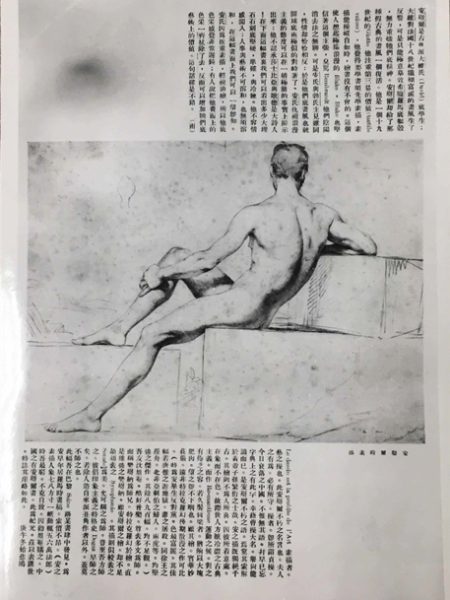
Philippe Cinquini, Jean-Auguste-Dominique Ingres, attr., Seated Male Nude Seen from the Rear, first decade of the nineteenth century (?) [让-奥古斯特-多米尼克·安格尔(传),《背转身的坐姿裸体男性》,创作于19世纪第一个十年(?)], dans Nineteenth-Century Art Worldwide, Volume 19, Issue 1, 2020.
Résumé:
During the winter of 2019–20, the Shanghai Museum hosted a major loan exhibition of late eighteenth-century and early nineteenth-century French academic art called La Naissance des Beaux-Arts (The Birth of the Fine Arts). To the eighty-five works borrowed from France, the Shanghai Museum was able to add a single work from its own collection: an academic drawing of a seated male nude, probably dating from the early years of the nineteenth century. The drawing, long attributed to Jean-Auguste-Dominique Ingres, has been in the possession of the museum since 1977, but it had never been shown by the institution before. For the duration of the exhibition, it was reunited with works by Ingres’s teacher, Jacques-Louis David (1748–1825), as well as other French artists from the reign of Louis XIV to the imperial regime of Napoleon, roughly from 1650 to 1815.
Displayed in a vitrine in the central room of the exhibition, the drawing of a young male model artfully posed on a series of wooden boxes formed an interesting counterpoint to the large Ecorché with Raised Arm of 1790 by Jean-Antoine Houdon, which, standing in the center of the room, commanded the exhibition. The reason for the drawing’s presence in the exhibition and its significance may not have been immediately understood by all. Indeed, the Shanghai drawing attributed to Ingres added little to the exhibition’s theme or to the knowledge of the draftsmanship of an artist by whom several thousands of undisputed drawings are known. However, this drawing played an important role in twentieth-century Chinese cultural history. It is the only French academic drawing in a museum collection in China, a destination it reached via a curious itinerary that was prompted by one of the first and best-known Chinese artists to have studied in France, the painter Xu Beihong (徐悲鸿; 1895–1953). After its arrival in Shanghai, the drawing was owned for many years by one of the most fascinating literary figures in 1930s China, Shao Xunmei (邵洵美; 1906–68), and his wife, the equally interesting Sheng Peiyu (盛佩玉; 1905–89), before it disappeared during the Cultural Revolution (1966–76). It eventually resurfaced and ended up in the Shanghai Museum. This article, then, is focused less on the drawing itself or even on the conundrum of its attribution to Ingres than on its cultural significance in early modern China.